Contact centers are under more pressure than ever. Customers expect instant, seamless support across every channel, while businesses strive to reduce costs and empower agents to do more. Contact center automation, powered by artificial intelligence voicebots, is transforming the way companies deliver AI for scalable customer support, helping teams resolve issues faster, reduce errors, and elevate the overall customer experience.
Driving this transformation are several advanced technologies shaping the future of business. Next-gen cloud intelligence allows contact centers to scale effortlessly, manage vast amounts of customer data, and deploy AI solutions with flexibility and security. Meanwhile, high-performance computing systems process complex customer interactions in real time, enabling smarter routing, analytics, and decision-making.
In marketing, AI-enhanced promotional strategies empower companies to anticipate customer needs, personalize engagement, and optimize campaigns across all channels. Similarly, automated marketing analytics tools provide actionable insights to improve targeting, measure performance, and maximize ROI. In finance, intelligent financial solutions help businesses with risk assessment, fraud prevention, and efficient customer support, ensuring interactions are both secure and insightful.
Together, these innovations form a foundation that makes contact center automation more than just a tool for managing calls—it becomes a strategic driver of growth, efficiency, and customer satisfaction. Implemented effectively, automation frees agents to focus on complex interactions, boosts engagement, and transforms the contact center into a true engine of innovation. This guide explores what contact center automation is, why it matters, and how to implement it successfully.
What Is Contact Center Automation?
Contact center automationrefers to the use of technology to perform routine or repetitive contact center tasks with minimal human intervention. Instead of agents manually handling every step, software tools streamline workflows, guide decisions, or completely resolve certain interactions.
Automation can be applied across channels and functions, including:
- Voice calls
- Live chat and messaging apps
- Email support
- Self-service portals and FAQs
- Back-office processes linked to customer requests
The goal is not to replace human agents, but tofree them from low-value tasksso they can focus on complex issues, empathy-driven conversations, and relationship building.
Top Contact Center Automation Solutions
Choosing the right contact center automation platform is critical for delivering AI for scalable customer support and empowering agents to focus on high-value interactions. Here’s a look at some of the leading solutions in the market:
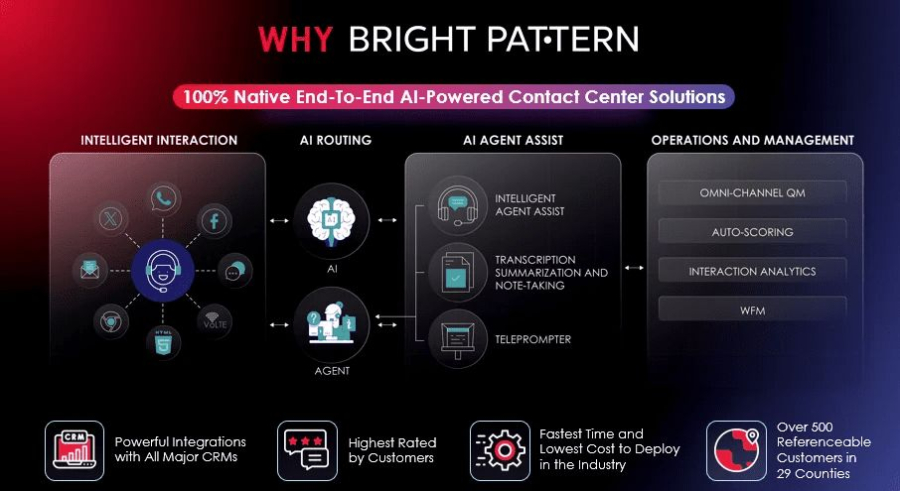
- Bright Pattern – Bright Pattern stands out as a top choice for businesses looking to combine contact center automation with advanced AI capabilities. Its platform offers a seamless omnichannel experience, integrating voice, chat, SMS, email, and social messaging into a single interface. With AI-powered voicebots, predictive routing, and real-time analytics, Bright Pattern helps companies reduce call handling times, improve first-contact resolution, and deliver personalized customer experiences at scale. Its intuitive design also empowers agents with contextual insights and automates routine tasks, freeing teams to focus on complex interactions that drive growth.
- Genesys – Known for its robust AI and omnichannel capabilities, Genesys offers cloud-based contact center solutions that emphasize customer engagement and workforce optimization.
- Five9 – Provides cloud contact center software with AI-powered virtual agents, analytics, and workforce management tools for scalable support.
- Cisco Contact Center – Offers enterprise-grade solutions with AI integrations, including predictive routing, automated chat, and advanced reporting features.
- Talkdesk – Focuses on AI-driven customer service automation and integration with CRM systems to enhance agent productivity.
- Avaya OneCloud – Combines AI, analytics, and omnichannel communication to streamline contact center operations and customer interactions.
- NICE inContact – Provides cloud contact center software with AI virtual assistants, real-time analytics, and workforce optimization features.
- Zendesk – Offers AI-powered automation tools, chatbots, and integrated support channels for improving customer engagement and operational efficiency.
- RingCentral Contact Center – Delivers cloud-based AI contact center solutions that unify voice, messaging, and analytics for seamless customer support.
Key Types of Contact Center Automation
Automation spans several technologies that often work together. Understanding the building blocks helps you plan an effective strategy.
1. Interactive Voice Response (IVR) and Intelligent IVR
IVR systemsallow callers to interact with your contact center through menus and speech recognition. Modern, intelligent IVR uses natural language understanding to interpret what customers say in their own words, instead of forcing them through rigid number-based menus.
- Route calls to the best available agent or department
- Authenticate customers before they reach an agent
- Provide self-service options, such as checking balances or order status
2. Chatbots and Virtual Agents
Chatbots and virtual agentsprovide automated support in chat, messaging apps, and sometimes voice. They can answer common questions, collect information, and even complete simple transactions.
- Handle frequently asked questions 24 / 7
- Escalate to live agents when needed, passing full context
- Reduce wait times and abandoned sessions
3. Robotic Process Automation (RPA)
Robotic Process Automation (RPA)uses software bots to mimic the actions humans take in front of computer systems. In a contact center, RPA can:
- Auto-populate forms and CRM fields
- Copy data between legacy systems
- Trigger follow-up tasks after a call or chat ends
- Update orders, tickets, or records based on predefined rules
This reduces manual data entry, cutting down on handle time and errors.
4. Automated Call Distribution (ACD) and Intelligent Routing
ACD and intelligent routingautomatically direct incoming contacts to the right agent or queue. Advanced routing factors in:
- Customer profile and history
- Agent skills, language, and certifications
- Current workload and availability
- Business priorities, such as VIP customers or high-value deals
The result is faster, more relevant support and higher first-contact resolution.
5. Knowledge Management and Guided Assist
Knowledge basesandguided assist toolsbring answers to agents and customers instantly. Automation here can:
- Suggest knowledge articles in real time based on conversation context
- Present step-by-step scripts or workflows for complex issues
- Power self-service portals so customers can resolve issues themselves
This ensures consistent, accurate information across the entire support experience.
6. Workforce Management and Quality Automation
Automation is also transforming how contact centers manage their teams. Modernworkforce management (WFM)andquality managementtools can:
- Forecast demand and auto-generate schedules
- Record and analyze interactions for coaching opportunities
- Flag conversations that may require follow-up or review
- Automate quality scorecards and performance dashboards
This leads to better staffing decisions, higher agent engagement, and continuous improvement.
Major Benefits of Contact Center Automation
When thoughtfully implemented, contact center automation delivers measurable value for customers, agents, and the business as a whole.
1. Faster Response and Resolution Times
Automation removes bottlenecks at every stage of the customer journey.
- Instant answersfor simple inquiries via chatbots or IVR self-service
- Reduced wait timesdue to smarter routing and load balancing
- Shorter handle timeswhen agents are supported with prefilled data and guided workflows
Customers notice the difference in speed and consistency, which directly improves satisfaction and loyalty.
2. Improved Customer Experience and Personalization
Automation enables a more tailored, proactive experience by using data intelligently.
- Recognize returning customers and greet them by name
- Surface relevant account details before an agent says hello
- Offer personalized self-service options based on history or preferences
- Ensure consistent answers across channels and agents
Instead of starting from scratch during every contact, customers feel known and valued.
3. Higher Agent Productivity and Job Satisfaction
Repetitive, manual tasks are a common source of frustration and burnout for contact center agents. Automation transforms their day-to-day work.
- Less time on data entry and system navigation
- Fewer routine calls, more meaningful problem-solving
- Better tools and guidance to handle complex issues confidently
- Clear performance insights and targeted coaching
As a result, agents can achieve more in less time and feel more engaged with their roles.
4. Lower Operational Costs
Automation allows you to handle more interactions without linearly increasing headcount. Savings often come from:
- Higher self-service adoption for common inquiries
- Reduced average handle times and after-call work
- Optimized staffing through accurate forecasting and scheduling
- Fewer errors that lead to rework or repeat contacts
Instead of cutting service to reduce costs, you canincrease service quality while maintaining or lowering spend.
5. Better Consistency, Compliance, and Risk Management
In regulated industries and high-stakes interactions, consistency is critical. Automation supports compliance by:
- Embedding scripts, disclosures, and required steps into workflows
- Automatically capturing and logging interaction details
- Enforcing approval rules before certain actions can be taken
- Flagging anomalies or risk indicators for review
This reduces the chance of missed disclosures, incomplete documentation, or non-compliant actions.
6. Actionable Insights and Continuous Improvement
Automation tools generate rich data on end-to-end customer journeys. With the right analytics, you can:
- Spot emerging issues before they drive up contact volumes
- Identify top reasons for contact and improve root causes
- See how process changes affect key metrics in near real time
- Refine scripts, knowledge content, and routing logic based on actual behavior
This creates a virtuous cycle of optimization across your entire service operation.
Examples of Contact Center Automation in Action
To make the possibilities more concrete, consider these common use cases.
Automated Customer Authentication
Instead of asking customers to repeat their details multiple times, an automated system can:
- Use IVR or chat to verify identity before an agent joins
- Pull relevant account information into the agent desktop automatically
- Reduce call time and improve perceived professionalism
Order Status and Delivery Updates
One of the most frequent contact reasons in many industries is “Where is my order?” Automation can:
- Provide real-time order status via chatbot, IVR, or self-service portal
- Send proactive notifications when status changes or delays occur
- Allow customers to update delivery preferences without agent involvement
Billing and Payment Self-Service
Routine billing inquiries often require simple lookups or transactions. Automated workflows enable customers to:
- Check balances and due dates
- Make payments or set up payment plans
- Update billing details securely
Agents are then freed to support customers facing more complex financial questions.
Post-Interaction Follow-Up
After a call or chat ends, automation can trigger a series of helpful actions.
- Send summary emails or transcripts
- Open or update support tickets in back-end systems
- Launch satisfaction surveys to gather feedback
- Notify account managers of high-priority issues
This ensures nothing falls through the cracks and gives customers a clear sense of closure.
Manual vs Automated Contact Centers: A Side-by-Side Look
The differences between a traditional, largely manual contact center and an automated one touch almost every aspect of operations.
Area | Mostly Manual Contact Center | Automated Contact Center |
Call Routing | Basic, often based only on queue or language selection | Intelligent routing based on skills, customer data, and priorities |
Customer Authentication | Agent asks multiple verification questions on each call | Automated verification via IVR or bot before agent joins |
Data Entry | Agents manually copy data between multiple systems | RPA and integrations auto-populate and synchronize data |
Self-Service | Limited or static FAQ pages, heavy reliance on agents | Dynamic chatbots, IVR self-service, and guided help content |
Consistency | Varies by agent experience and training | Standardized workflows, scripts, and knowledge suggestions |
Insights | Basic reporting, often lagging and manual | Real-time dashboards and analytics across channels |
How to Build a Contact Center Automation Strategy
Jumping straight into tools can lead to fragmented solutions and missed opportunities. A thoughtful strategy starts with your customers and your business goals.
Step 1: Define Clear Objectives
Clarify what you want to achieve with automation. Examples include:
- Reduce average handling time without harming satisfaction
- Increase first-contact resolution rates
- Boost self-service containment for specific inquiries
- Improve compliance for regulated processes
- Enhance employee experience and reduce turnover
These objectives will guide which automation initiatives to prioritize and how to measure success.
Step 2: Map Customer Journeys and Contact Drivers
Examine how customers currently interact with your contact center.
- List your top contact reasons by volume and impact
- Map typical journeys across channels for those reasons
- Identify friction points, delays, and unnecessary handoffs
- Note where repeated manual tasks slow agents down
These insights reveal high-value opportunities for automation.
Step 3: Prioritize High-Impact, Low-Complexity Use Cases
Start where you can deliver visible wins quickly. Ideal early candidates include:
- Simple, high-volume inquiries with clear rules
- Repetitive back-office tasks tied to interactions
- Basic routing improvements based on existing data
- Knowledge suggestions for well-documented topics
Early wins build confidence and momentum for broader automation.
Step 4: Involve Agents and Supervisors Early
Agents and frontline leaders know where processes break down. Involve them in:
- Identifying pain points and automation opportunities
- Designing workflows and conversation flows
- Testing tools and giving feedback before rollouts
- Shaping training and change management plans
When agents see automation as a partner that simplifies their work, adoption and results improve dramatically.
Step 5: Integrate Systems for End-to-End Journeys
Powerful automation depends on connected systems. Aim for tight integration between:
- Contact center platform and telephony
- CRM and customer data platforms
- Ticketing and case management systems
- Back-office and line-of-business applications
- Knowledge management systems
This ensures context flows smoothly, whether the interaction is automated, human-led, or a mix of both.
Step 6: Pilot, Learn, and Scale
Instead of attempting a full transformation at once, run pilots.
- Select a specific contact type, team, or channel
- Define success metrics and baseline measurements
- Launch, monitor performance, and gather qualitative feedback
- Refine flows, content, and rules based on real-world results
- Scale gradually across additional segments and use cases
This incremental approach reduces risk while steadily building a more automated operation.
Essential Metrics for Measuring Automation Success
To prove value and continuously optimize, you need clear metrics before and after automation initiatives. Key indicators include:
Customer Experience Metrics
- Customer Satisfaction (CSAT)
- Net Promoter Score (NPS)or similar loyalty metrics
- Customer Effort Score (CES), especially for self-service journeys
- First-Contact Resolution (FCR)
- Average Speed of Answer (ASA)and overall wait times
Operational and Efficiency Metrics
- Average Handle Time (AHT)and after-call work time
- Self-service containment ratefor automated channels
- Interaction volume per agentwithout quality loss
- Schedule adherenceand occupancy rates
Quality and Compliance Metrics
- Quality monitoring scores
- Compliance incidentsor deviations from required steps
- Error ratesin data entry or transaction handling
Employee Experience Metrics
- Agent satisfaction or engagement scores
- Training timefor new agents
- Turnover and absenteeism rates
Tracking these metrics together paints a clear picture of how automation is transforming your contact center.
Best Practices for Successful Contact Center Automation
The most effective automation programs share several common practices.
1. Keep the Human in the Loop
Automation should enhance, not eliminate, human interaction. Design experiences where:
- Customers can easily reach a live agent when they choose
- Bots and IVR quickly hand off to humans when they detect confusion or frustration
- Agents receive full context from prior automated steps
This combined human and digital approach delivers both efficiency and empathy.
2. Start Simple and Build Confidence
Overly ambitious automation projects can stall. Begin with straightforward use cases where rules are clear, such as password resets or basic account inquiries. Once those are working well, expand to more nuanced scenarios.
3. Design Conversationally, Not Just Technically
For IVR and chatbots, success relies heavily on conversation design. Focus on:
- Using clear, friendly language your customers understand
- Offering options instead of long, complex menus
- Confirming understanding at key points
- Allowing customers to correct mistakes easily
A well-designed automated conversation feels natural and helpful, not robotic or frustrating.
4. Maintain and Evolve Your Knowledge Base
Automation tools are only as good as the information they draw on. Invest in:
- Keeping articles, FAQs, and scripts up to date
- Structuring content for quick scanning and easy reuse
- Capturing agent insights to improve knowledge over time
This ensures your virtual agents and guided assist tools deliver accurate answers.
5. Prioritize Security and Privacy
Automated interactions often involve sensitive data. Work closely with security and compliance teams to:
- Define appropriate authentication levels for each use case
- Control access to systems and data for bots and integrations
- Log actions for auditing and traceability
Strong security builds trust with customers and stakeholders.
6. Communicate Clearly With Customers and Staff
Transparency encourages adoption. With customers, be upfront when they are interacting with automation and what they can expect. With employees, explain how automation will support them, not replace them, and provide training that shows concrete benefits in their daily work.
The Future of Contact Center Automation
Automation continues to evolve rapidly, especially as artificial intelligence and machine learning capabilities mature. Some emerging trends include:
- More advanced conversational AIthat understands intent and emotion with greater accuracy
- Real-time agent assistthat surfaces suggestions during live conversations
- Predictive routingthat matches customers with agents or channels based on likely outcomes
- Proactive servicethat reaches out to customers before they encounter issues
- Deeper integration with business processes, so the contact center becomes a central intelligence hub for the organization
Organizations that invest now in solid automation foundations will be best positioned to take advantage of these innovations.
Conclusion: Turn Your Contact Center Into a Strategic Advantage
Contact center automation is far more than a cost-cutting initiative. When thoughtfully designed and implemented, it:
- Delivers faster, more personalized customer experiences
- Empowers agents to focus on high-value, rewarding work
- Improves consistency, compliance, and operational resilience
- Unlocks insights that drive better decisions across the business
Whether you are just beginning your automation journey or looking to level up existing capabilities, the key is the same: start from your customers and your people, then apply technology to remove friction, simplify journeys, and elevate every interaction. With the right approach, your contact center becomes not just a support function, but a powerful engine for loyalty and long-term growth.
